


Principle 3: Strategy
The governing body ensures that the organisation's purpose, strategy and business model support performance that creates sustainable value within the organisation's economic, social and environmental context.
Exception declaration
All the recommended practices in support of Principle 3 have been implemented.
Specific disclosures
(a) Disclosures in relation to organisational ethics:
- A high-level description of the organisation's purpose, its strategy and business model.
The setting of strategic direction and support of holistic operational performance are the primary responsibilities of the board. The strategy development process identifies relevant factors across the operating context, risks, opportunities, financial performance, business model relevance and sustainable development matters, which are considered in terms of the group's purpose, vision, targets, medium- and long-term goals, and underlying corporate values for annual board approval.
The board delegates the formulation and management of strategy and execution to management. The board-approved Strategy Risk Principles Policy addresses the risk principles to be considered in the development of strategy. The policy is considered and approved by the Group Directors' Affairs Committee (Group DAC) and the board through the annual review of the Nedbank Group Limited Enterprisewide Risk Management Framework (ERMF).
The board ensures that a robust strategy process is defined and executed. The strategy planning timetable entails detailed business planning at business unit and Group Exco level and a strategy review by the board that culminate in final approval of the strategy framework by the board in August and the final approval of the group business plan in November (by both Group Exco and the board). Nedbank has a rolling 3-year planning window that is focused on value creation and underpinned by strategic choices and goals that consider the economy, society and environment, as well as the broader operating context. Management initiates the strategy review and business planning process in January with Group Exco.
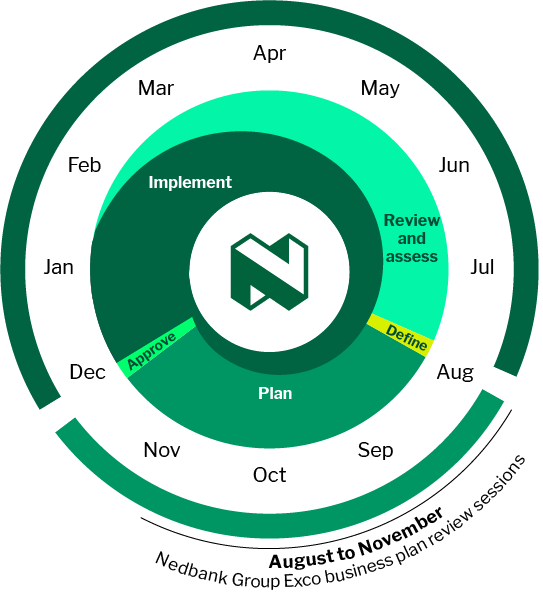
The major macro trends in our operating environment are identified by analysing political, macroeconomic, social, competitive, technological, regulatory and environmental drivers. The effect of these trends on our client base and strategic objectives is assessed. Continued engagement with material internal and external stakeholders takes place and their needs and expectations are considered. Stakeholders include employees, clients, shareholders, regulators and communities. This process assists in highlighting whether any changes are required to any of Nedbank's material matters – i.e. the issues that have the most impact on our ability to create value, with both opportunities and risks looked at to ensure that the strategy remains contextually relevant. Risks and opportunities arising from the material matters are identified and their impact on the short-, medium- and long-term strategies is assessed. The material matters are also considered in the context of Nedbank's purpose, vision, targets and long-term goals. This continual scanning and review process ensures that we are staying close to changes in the operating environment, enabling us to proactively review our strategic choices should there be significant changes in the material matters.
The outcome of this analysis assists in assessing the appropriateness of the current strategy and further informs any new strategic focus areas for the business planning window, which spans the following 3 years.
For more information regarding our strategy, please refer to the section titled 'Sustainable value creation through our strategy' in our 2025 Integrated Report.


