


Nedbank’s purpose guides our strategy and contribution to sustainable development. We use our financial expertise to support positive social and environmental outcomes, while managing risks that affect the people we serve and the ecosystems we depend on. This is embedded in the same strategic framework that drives growth, client experience and digital leadership.
Our Sustainable Development Finance Framework connects our purpose to our core business. It guides capital allocation, opportunity identification, risk management and efficient use of resources across:
a) Core business: through sustainable finance, financing the transition and financial inclusion.
b) Operations: through responsible business practices, policies, procurement and our people.
c) Corporate social investment: through our Social Impact Unit (SIU) and circular green economy strategy.
We focus primarily on 9 of the 17 United Nations Sustainable Development Goals (SDGs) where our lending, investment and product innovation can create the most measurable outcomes.
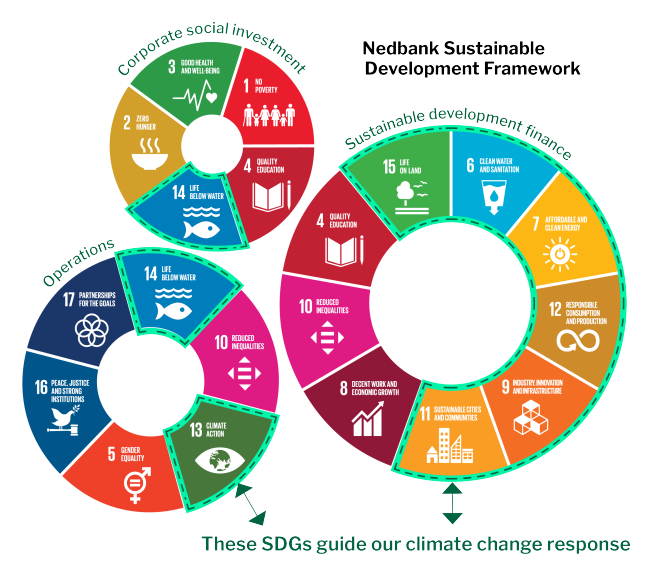
Pursuing sustainable development goes hand in hand with managing the risks that climate change, nature loss and social inequality pose to our business and our clients. We assess these risks systematically across our lending portfolio – through our social and environmental management system, Climate Risk Management Framework, nature risk assessment, climate and nature position statements and Energy Policy – and use them to inform how we engage clients, structure transactions and evolve our portfolio over time.
At the end of 2025 our sustainable development finance portfolio stood at R207bn, representing 21% of our total lending. Our target is 25% of total gross loans and advances by 2030.
South Africa’s transition context is distinct. Energy insecurity, water scarcity, infrastructure gaps and the cost of capital shape what is feasible and how quickly change can happen. As a bank rooted in South Africa’s economy, Nedbank has both the opportunity and responsibility to direct capital in ways that support participation, resilience and long-term growth.
Read our full sustainability reports and policies in the resource centre.
The Nedbank Board of Directors is accountable for how the group fulfils its purpose, including oversight of sustainability and climate-related risks and opportunities. The board takes a systems view, considering short-, medium- and long-term implications for the business and its stakeholders.
Board-level sustainability oversight operates through 2 primary committees. The GSCRC oversees climate and environmental priorities, including the low-carbon transition, climate risk management and net-zero commitments. The Group Transformation, Social and Ethics Committee oversees Nedbank’s social mandate, including transformation, financial inclusion, ethics, human rights, employee wellbeing and stakeholder relationships.
Three additional board committees support this oversight: the Group Risk and Capital Management Committee, Group Credit Committee and Group Remuneration Committee. At management level, the Sustainability Risk Committee translates board direction into action and integrates sustainability- and climate-related risks into day-to-day management.
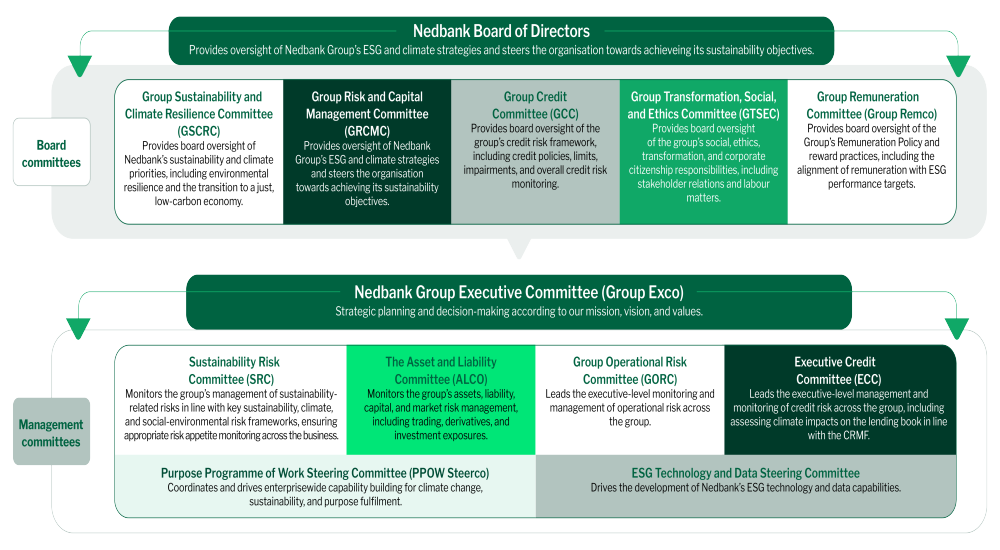
ESG objectives are embedded in executive performance scorecards and influence variable pay outcomes. Short-term incentive awards for group executives are determined through scorecards that incorporate both financial and non-financial ESG metrics. Long-term incentive awards are fully conditional on achieving corporate performance targets over a 3-year period, including progress against sustainability and broader ESG priorities.
Nedbank's policies and procedures are publicly available and span the full scope of our governance and sustainability commitments, which cover the environment, sustainable finance, human capital, ethics, market conduct, information risk, corporate governance, procurement and suppliers, compliance, tax and our memoranda of incorporation. These documents provide transparency on the principles, standards and frameworks that guide how we operate, lend, invest and engage with stakeholders.
Read more in our 2025 Governance Report.
